|
Branding Laws · Internet Marketing · eMarketing · Internet Advertising · Online Branding |
| |
According to BIGresearch's June Consumer Intentions and Actions Survey, when asked how often they research products online before buying them in person or in a store, 87% of nearly 7,500 respondents said they did so occasionally to regularly. Of those who said they researched products online before buying them in the store:
The survey also divided these respondents into two income brackets to profile which items were most frequently researched online, but purchased in person, by those making above and below $50K per year.(
Joe Pilotta, VP of Research for BIGresearch, said "Those in the higher income bracket researched and then bought electronics most often, followed by home improvement items and appliances. The other group reported electronics, apparel and medicines/vitamins/supplements as their top three products researched online, then purchased in person."((
Types Of Products Researched Online In Last 90 Days Before Buying in Person (% of respondents) |
|||
Top 5 Products Researched Adults (18+) $50K+/yr. |
<$50K/yr. |
||
Electronics 39% 43% |
35% |
||
Apparel 17% 18% |
17% |
||
Appliances 17% 20% |
15% |
||
Home Improvement Items 16% 21% |
14% |
||
Medicines/Vitamins/Supplements 15% 14% |
16% |
||
Source: BIGresearch CIA, June 2006 |
|||
In both income groups, the top search engine used for product research was Google.com by a large margin, but WalMart.com made a surprising appearance in the top 5 websites used first among those who did their comparative shopping online before buying in the store.
Websites Viewed First When Researching Products (% of respondents) |
|
Top 5 Search Engines Used Adults (18+) $50K+/yr. |
<$50K/yr. |
Google.com 22% 27% |
20% |
Yahoo.com 8% 7% |
8% |
Amazon.com 6% 7% |
5% |
Ebay.com 3% 2% |
4% |
WalMart.com 2% 1% |
3% |
Source: BIGresearch CIA, June 2006 |
Pilota concludes, "... Retailers cannot view online as ancillary to the store, rather retailer websites must be viewed as extensions of the bricks and mortar as well as a concentrated shopping experience."
Everything You Need to Know About AdSense Stats (But Were Afraid to Ask) |
|
When it comes to building great revenues on AdSense, nothing is more important than following your stats. The effect of any change you make to your site, to the positioning of your ads or to their layout or color is going to have a direct impact on the behavior of your users. That's going to be clear in your stats. You'll see it in your click-through rate and you'll see it most importantly in your revenues.
You need to check your stats regularly. A week after you've made a change to the way your site looks, you should check back in to see what that change did... and whether it brought you more money or less.
But your stats won't tell you everything. They might tell you whether or not you've made more money this week than last week but they won't tell you what you need to do to make even more money next week. If you really want to find out what your users are up to - and get more of them doing the things you want - you will need to use some additional tools.
Tracking Programs
The Internet is packed with tracking tools for AdSense. Some of those tools are just plain useless; others you really don't want to do without. In my book, Google AdSense Secrets, I give an introduction to each of the main programs and point out which ones you absolutely must have if you want to maximize your revenues. For now though, just bear in mind that the tracking program you use should let you see where your visitors are coming from, where your clicks are coming from and which keywords your biggest clickers are searching for when they find your site on a search engine.
Once you've got all that information, it's a breeze to use the various AdSense strategies to optimize your site and get more visitors clicking on the highest paying ads.
Graph Builders
In addition to tracking programs that tell you information that you can't find out any other way, you should also use graph builders that make your information a snap to compare and analyze. They convert your figures into graphs so that you can see with one look how your CTR is changing and how your revenues are improving. Some of the best tracking programs include this option but even if you've bought the wrong one, it's still worth downloading a graph builder - especially if you don't really have a head for figures.
For more Google AdSense tips, visit http://www.adsense-secrets.com
Copyright © 2005 Joel Comm. All rights reserved
Google continues an active week of product releases and updates by making its AdWords Editor available to anyone who wants to download a copy.
An invitation-only beta test of AdWords Editor began in January. That beta has been opened up to more users, as Search Engine Roundtable noted the release of the product for download.
The AdWords Editor provides an offline way to work on an AdWords campaign. Advertisers can pull in all of their campaign information from Google, view statistics, make bulk changes, and upload the alterations back to Google from the editor.
Working offline allows the advertiser to prepare changes and have them ready to go at a future date. Businesses with a seasonal or shorter cycle for running campaigns can stay a step ahead of each needed update. When the time comes to rollout the new campaign, it can be retrieved with the AdWords Editor and sent online.
While any of Google's AdWords clients can use the software, the company sees the greatest benefit coming to those who have large accounts, with multiple campaigns and lengthy keyword lists. The AdWords Editor can manage several AdWords accounts as needed.
Everything starts with a download of the free editor. The user will be prompted to add an account, and after downloading the campaigns can start editing them.
Although the current version of the software comes in a Windows-only version, the Digital Inspiration blogger Amit Agarwal claims Mac and Linux versions are expected soon.
As part of a limited AdSense beta test, Google is offering new types of graphical and interactive advertisements to publishers, according to Jennifer Slegg, the Google AdSense forum moderator at Search Engine Watch.
AdSense is experimenting with interstitials, the full-page ads that come up when you click on a Web page, expanding ads that can be enlarged with a click or mouse-over, and floating ads that drift onto the screen from the side of the page, she wrote in a posting on her blog.
"If AdSense offered rich media to all publishers, it could really hurt competitor companies offering similar rich media ad formats because of the vast number of publishers that AdSense has," she wrote. "In terms of dominating the online advertising market, AdSense rich media could seal the deal to make AdSense the force to be reckoned with, by not only dominating the online text ad and graphical banner-style advertising, but in the entire online advertising market--definitely a story to watch."
A Google representative said the company has nothing to announce at this time.
Google launched a beta this week for its AdWords Editor application. The search company has quietly been testing out two new features for AdWords advertisers including a desktop application to manage AdWords campaigns and longer text ads.
As a downloadable account management application for Windows, AdWords Editor allows users to make changes to multiple AdWords campaigns, in multiple accounts, and then upload the collective changes to Google’s system.
Though the application is only available in English, for Windows 2000 or Windows XP users so far, Google plans to add other languages and platforms in the future. The company revealed little about AdWords Editor in its talks with ClickZ, offering this statement, “We are currently conducting a test of the AdWords Editor with a limited number of advertisers. In the future, we plan to open this up to a broader set of advertisers. At this time we don’t have any specific details to share about the scope of the test or future plans.”
The other feature Google is currently working on is longer text ads on its search results page. The company is starting to allow some advertisers and keywords to roll over the 70-character limit. Yahoo, in December, went in the other direction cutting its original 190-character limit to 70-characters. Neither company could be reached for comment by press time.
By Neil Anuskiewicz
Most businesses want a cost-effective way to bring in more customers. The challenge is to find prospects who are thinking about your products at the precise time that you reach them.
With the advent of Google AdWords, it is now possible to target prospects at the very moment they are thinking about buying your products or services. If someone does a Google search on digital cameras, they only see ads for digital cameras. If someone does a search on organically grown coffee beans, they only see ads for organically grown coffee. Google AdWords enables you to implement precisely targeted advertising.
Read on to learn how to maximize your success with Google AdWords. With proper preparation and execution, starting Google AdWords can be like planting a money tree that will provide your business with a steady stream of revenue.
Google AdWords: A Definition
Open up a Web browser and go to the Google website. Type in the search term "coffee" and click "search." Essentially, two types of search results come up: on the left and below are the organic search results that nobody has sponsored. On the right side of your browser window and sometimes above the organic results are the Sponsored Links. The Sponsored Links, which always are identified as such, are paid advertisements.
As participants in this automated auction, each of these advertisers is bidding for the keyword coffee. They only pay if someone is interested enough to click on the advertisement. If nobody clicks on the ad, the cost is zero. The higher the advertiser bids on a keyword, the higher in the rankings the ad appears and the more likely Web searchers will see it. Ranking means visibility, though you do not have to be at the top of the rankings or bid the highest amount for prospects to see your ad and click on it. Your goal is to get the lowest cost-per-click (CPC) and the highest quality clicks (sales and leads) for your budget.
Many companies compete for popular keywords such as coffee. The only way to find out if a particular keyword will work for you is to try it. The problem is that many other advertisers are bidding for the popular keywords so your CPC is likely to be high. You are more likely to get a low CPC with more obscure, highly targeted keywords. It takes some thought to come up with the right keywords.
Our coffee roaster would probably want to try the keyword "coffee," and watch it like a hawk as it could result in many low quality clicks (not many conversions to leads or sales). If a keyword does not produce high quality clicks after a reasonable trial period (a couple weeks, perhaps), then remove it. It may even be obvious sooner that a particular keyword is costing money but not producing results.
Perhaps our coffee roaster sells shade-grown coffee that protects Central American songbird habitat. While far less people are searching for shade grown coffee than just coffee, it is likely to yield a lower CPC and higher quality clicks.
Do some brainstorming and write down an initial list of keywords that matches your market niche. The process of finding targeted keywords will be a useful exercise to help focus your campaigns and maximize your return on investment.
Getting Started
The first thing you need to get started with AdWords is a goal. Is your goal to make direct sales via e-commerce on your website? Is your goal to capture sales leads that you can follow-up with and make the sale? Alternatively, is your goal a combination of both of these outcomes? Once you have determined a goal you need a website that helps you achieve that goal.
Your website should be eye-catching and well organized, and include landing pages for your products or services. It's easy to find samples of landing pages. Simply search for the product or services you offer and look at what other companies in your market are doing. The landing page can be your main website home page if your site tightly focuses on one product or service (e.g., this permission-based email marketing website). Otherwise, the landing page should be a page within your larger website that focuses on the specific product or service you are advertising (e.g., this page for web hosting).
If you are selling directly from your website, your site should include a secure e-commerce system. Any technically competent Web design firm can set this up for you. Here is an example of a secure form: email marketing free trial.
If you want sales leads, your site should include a "call to action" to persuade people to request more information. The way they submit a lead is to click on a link to a "lead capture form." You need a form that at a minimum sends you—or the appropriate sales staff—an email. Ideally, it also will create a lead for you in a Customer Relationship Management (CRM) system such as SalesForce or SugarCRM. Here is an example of landing page for website design, and the lead capture form for that service. Our lead capture form both sends an email to sales and creates a lead in SugarCRM. You can then, of course, call and email the prospect.
Whether you are selling directly from your website or capturing leads, your website should always have obvious ways to reach using whatever method with which the prospect feels most comfortable: a contact form, email, or telephone. Some company websites make it hard to figure out how to contact them for more information.
It is important to have a number of people – both inside and outside of your company – test your website for usability and ease of use. Prospects should never have to wonder how to buy from you or how to contact you to ask a question about your products or services.
In my next column, I'll discuss some of the mechanisms to maximize sales on the Web. These include targeting your product or service, structuring advertisements, choosing keywords and other important topics.
|
By Rene Agredano |
|
I'm not an online marketing expert, and am just now starting to get a grasp on it after years of being immersed in the development of printed marketing materials. But since the launch of my company's own online storefront, MarcomAndPOP.com, it's been vital to learn more about online marketing and concepts like “Cost-Per-Click” (CPC), “Cost-Per-Impression” (CPI) and “Search Engine Optimization” (SEO). Calling in the experts If you also have a Web storefront that needs a marketing boost, it pays to frequently attend seminars or webinars (http://www.MarketingProfs.com), read up on industry news (http://www.SearchEngineGuide.com), and pay an expert to analyze your site (http://www.RedwoodTech.org). Online marketing experts can offer strategies to improve your site's ranking on the Web, and work with you to implement them. You can find these experts locally, just visit the RTC's member roster or e-mail me for our printed Member Directory. Recently, my company worked with a fellow RTC member company that specializes in this area. This team of experts assisted us with the understanding of SEO tactics; implemented certain rank-building strategies such as use of “Alt Tags,” “Page Titles” and “Meta Descriptions”, gave us background on “keyword” strategies, and provided an overview of online advertising options. Adwords pays off One advertising option was Google's Adwords program, which you've undoubtedly seen in action whenever you Google something. Every time you do a search, those unobtrusive but relevant text ads that appear to the right and top of your search results are not only how Google makes most of its money, but they're also one of the best ways that small business owners can experience Web advertising success. The Adwords program is based on a “Cost Per Click” (CPC) concept. Each time someone searching Google clicks on your ad, you get charged a small fee. You pay only for the clicks you've received at a price that you've already set. You can choose a maximum CPC from 1 cent to $100, and a maximum daily amount that you're willing to spend. There are no monthly minimums, and just a relatively small fee to set up the account. What sets Google's program apart from other online advertising is that you are in total control of your campaign and what you spend. For MarcomAndPOP.com, our Adwords campaign currently consists of two product categories. For each category, we've written multiple ads. Each ad links directly to a specific product that we want viewers to see if they click on the link. We can change the ads 24/7, and change the individual amounts that we're paying for each ad that gets clicked on. Google provides us with tools to find the best key words for our ads, see how everything is performing, track who clicked on what ad, and who purchased what product. Without adding staff and by spending a fraction of what we would with other advertising tactics, we've experienced a noticeable sales increase directly related to our Adwords campaign. If you want to try it, be sure to take advantage of Google's “Jumpstart” program for new advertisers. For $299 Google's team will analyze your website, put together a number of suggested ads and keywords to get you started, and even give you $299 in credit toward your clicks fees. Just be sure to review your campaign to gain an understanding of how to mange it prior to starting your ads. Do your keyword homework With Adwords, I've noticed that there are those who tried it and love it, and those who tried and say it was a big waste of money. Yes, it can be a money pit if you don't do your homework. Don't start until you learn what key words people are looking for when they search for your products. Words we often use to describe our products are just industry speak, and nothing like what people use when they search online. Try the online service www.WordTracker.com for ideas. WordTracker is practically free, and offers a selection of subscription rates that start at around $8 for a one day use. Finally, there is a growing risk of “click fraud” and you should know what to look for to make sure it doesn't happen to you (”How Click Fraud Could Swallow the Internet,” by Charles C. Mann, Wired Magazine, January 2006.) RTC members: your neighborhood experts The SEO firm we hired has paid off nicely. Adwords has been the best marketing strategy we've implemented for our site, and the only one that has shown immediate return on our investment. If you have a storefront or just want to drive traffic to your site, you too can boost your online sales today by going to the RTC's website and contacting a local online marketing expert to help you get started. Rene Agredano is a RTC member and co-owner of Agreda Communications, a one-stop shop for total marketing communications and point-of-purchase graphic solutions available online at www.MarcomAndPOP.com. She can be reached at rene@agreda.com. |
http://www.usatoday.com/tech/news/2005-03-10-google-ads-usat_x.htm
Giguère has one of those ubiquitous "Ads by Google" links on his site, offering ads the search giant considers of interest to readers. You might think that people rarely click on them, but they do — and often.
"For my own, personal humor writing, I got paid," Giguère says. "It certainly opened my eyes to the possibilities that were out there."
How AdSense works
Google has a simple proposition for anyone who owns a Web site: Let it put up links to its ads, and Google's AdSense program will give you a piece of the action when someone clicks on them.
It's found money for many bloggers, small e-tailers and huge businesses — from small personal sites such as Giguère's, to those of big-time corporations such as Amazon.com, the New York Times and About.com.
Giguère was so inspired, he wrote a book, Make Easy Money with Google, coming in May from Peachpit Press. Hundreds of online forums and Web sites are devoted to AdSense tips and tricks. The downside of the AdSense economy, critics charge, is that the avalanche of ads has created a new form of spam and is destroying the integrity of sites.
"This is a program that rewards people not for creating the best content, but for how to create sites to attract more advertising," says Danny Sullivan, editor of Search Engine Watch online newsletter. "AdSense has nothing to do with search. It effectively turns the Internet into a billboard for Google's ads."
Google, whose executives often say their mission is to organize the world's information, naturally begs to differ. "If I do a search for the New York Times and see an ad offering a subscription discount, that's useful to me," says Susan Wojcicki, Google's director of product management.
Web site publishers don't disagree.
"Say I write an article about a Braun shaver," says Chris Pirillo, who runs the Lockergnome.com gadget Web site. "I publish it, and within minutes, I have targeted ads about shavers on my site. Someone who reads the content may feel compelled to pick one up. That helps me and the reader."
Tales of AdSense riches range from a few hundred dollars a month to $50,000 or more a year, though high-dollar paydays are rare. They require a Web site with tons of traffic and the ability to put in 18-hour days working the system.
Pirillo, who has a following from his former role as a host on the now-defunct TechTV cable channel, says he's clearing more than $10,000 a month.
Before AdSense, which began in March 2003, bloggers and other small Web publishers had fewer options to make money. They could put banner ads on their sites for a host of non-related products, or commission programs from Amazon and eBay. "It was a lot more work, and you didn't get much of a return," Pirillo says.
With AdSense, "You write content, publish it, and the money starts to pour in," he says.
When he published the now-defunct Silicon Alley Reporter magazine, Jason Calacanis says, he used to suffer from insomnia, worrying about his monthly $200,000 to $400,000 printing bill.
He now runs a company called Weblogs, which publishes 75 Web sites on such topics as cars, gadgets, digital music and video games. He sleeps much better, he says, because "with AdSense, you know you're always making money. Your life gets a lot easier."
In his first four months of Web publishing, AdSense brought in $45,000. Some of his blogs produce $3,000 a month. His best do "four figures," Calacanis says, though he's reluctant to fill in the exact numbers. "And that's with zero marketing," he says.
How it works
Google and Yahoo dominate the booming online search advertising business, which is expected to grow to $5.6 billion in 2008, from $2.7 billion in 2004. Profit from search advertising enabled Google to more than double its revenue in 2004, to $3.1 billion.
The concept — text ads that appear next to search results — works on a "pay-per-click" model. Advertisers pay only if someone clicks on an ad. To use the programs, advertisers buy "keywords" for anywhere from 5 cents to $100 a word. Those are the terms people type into query boxes when they're searching, such as "Atlanta wedding photographer" or "Omaha Italian restaurants."
AdSense works as a part of that keyword model; it's an offshoot of what Google calls its AdWords program, which competes against Yahoo's Overture unit.
AdSense is a bonus program for advertisers who use Google AdWords. Through AdSense, Google clients get to tout their wares beyond Google's home page — potentially reaching more than 200,000 participating Web sites.
Small Web site operators have flocked to AdSense as a way to attract advertising. To participate, they sign up at Google, which reviews the site. Once a small piece of computer code language is implanted on an accepted site, Google does the rest — matching ad links from its warehouse of clients to appropriate sites.
There's an art to optimizing a site to attract more links — and generate more revenue.
Gay Gilmore, who runs Seattle-based recipezaar.com, says the trick is to attract ads next to recipes beyond the main page. "The ads need to be targeted," she says, "so that when someone is reading about chicken soup, an ad for one of the ingredients is of keen interest."
Web site publishers need to be creative, says Dave Lavinsky of TopPayingKeywords.com, an AdSense advice site. A house painter advertising his services on a homemade site is leaving money on the table if he mentions only house painting, he says. "'Housepainting' is a 20-cent word. 'Home improvement' is worth $2, so you should create content for that."
But Sullivan says keyword tricks hurt the editorial integrity of sites. Another problem, he says, is the proliferation of computer-generated directories with links to hotels, restaurants and entertainment and no real editorial content, fueled by the availability of "Ads by Google" checks.
Wojcicki says Google tries to review all sites in its program, and removes offenders such as the directory sites. Critics say the site reviews can sometimes result in an FCC-like "family friendly" filter. Bloggers complain about being rejected for discussions of sexuality and use of four-letter words.
"I begged, argued and appealed to reason for months," says author Susie Bright, whose site discusses sexuality issues. "I pointed out that all my postings were things you could easily read in ... any number of mainstream magazines that cover sex and politics from a fairly sophisticated point of view. And I pointed out that my readers like to buy trousers, go on vacations, purchase ink and basically buy all the same things that everyone else does."
Wojcicki wouldn't address the specifics of Bright's concerns, but says AdSense isn't for everyone. "We're very careful about who we let into our network. We reject sites with content some people may feel uncomfortable about."
With pay-per-click ads, Google and Yahoo are locked in a bitter battle for advertiser dollars. But Yahoo doesn't compete with AdSense for small publishers — yet. Yahoo says it will introduce an offering later this year.
For now, Google's most notable AdSense competitor is privately held Kanoodle, which accepted Bright's site. It works with small publishers and big ones (including USATODAY.com and MSNBC) and differs from AdSense in that advertisers can choose topic areas of the sites where they want their ads to appear.
"The search advertising market is red hot right now, and publishers and advertisers want more," says Kanoodle CEO Lance Podell. "We offer them more places to show their ads, and they love that."
How long will search sizzle?
Google's initial public stock offering last summer was a Wall Street sensation. The stock opened at $85 a share and now sells for around $180, down from its 52-week high of $216. Some analysts fret that the red-hot paid search market could start to cool down.
Forrester Research, revising downward earlier projections, expects 30% growth in search advertising revenue this year, after a 45% jump in 2004.
"Click fraud" is another nettlesome issue for Google and Yahoo.
Advertisers pay for ads only when they're clicked, but it doesn't always work that way.
Some competitors click ads just to run up the other guy's bills. Web publishers with AdSense get their friends to click ads so they can get more money. Some savvy webmasters have set up automated clicking models called "Hitbots" or "Clickbots," which click away all day, and cost the advertiser.
Such efforts "threaten our business model," Google CFO George Reyes said at a recent industry conference. "Something has to be done about this, really, really quickly."
University of California professor John Battelle, who is writing a book on search, says the success of AdSense has built a "growing, extremely sophisticated offshore industry."
"There are more of these sites than you can imagine," he says. "The robots click on the ads and then none of the clicks turn into leads for the advertisers. That's not how it's supposed to work."
Google and Yahoo say they are working on the problem, but Battelle doesn't think that's enough.
Yahoo, Microsoft and America Online have banded together on several occasions to fight e-mail spam, and Battelle says Google and Yahoo should show the same kind of joint leadership. "Because if they don't, it will end up biting them in the butt."
Let's apply our Branding Laws to Internet Advertising. The first law is about repeating success. I think when it comes to Internet Advertising, Google again has done an unbelievable job. It is amazing how many innovative Internet Advertising Tools have originated from Google.

Google AdWords Select is an amazing Internet Advertising tools. I also like Overture and Yahoo. If you can think of others, email us and we will add them to this section. Try to apply the laws. We also like people who advertise on AdWords Select. Send us your choice for innovative advertisers on Google, Yahoo or Overture.
The second law is about doing a bit more. We wait for your input.
The third law is about perceived quality. Which website or company do you think add more to you if you buy from them. Who do you think has done the best when it comes to this law?
The fourth law is about price. Which website do you think, with the right Internet Advertising, has convince you that price is not an issue?
The fifth law is about primary and secondary motivations. Which website do you think has used the law of secondary motivations to their best interest? Try to show us their Internet Advertising.
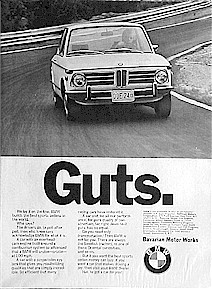
The rest of this page is inspired by a book called Guts by John Lyons; Some Excerpts:
There is no such a thing as a dull product; only dull approaches to an interesting product
There are no failures, only ineffective solutions
|
VW Ad: It was the only thing to do after the mule died |
John Lyons: "Who can confidently say what ignites a certain combination of words in an online advertising, causing an explosion in the mind of the consumer to jump, go and buy your new product. Inspired online advertising and copy is a mystery. Any attempt to explain it is a mystery story in thin disguise."
John Lyons in his book, GUTS, likes the winning definition by Leo Burnett: "The greatest thing to be achieved in copy is to be believed, and nothing is more believable than the product itself."
Here is my own definition: " The best online advertising, with simplicity and style, creates a dream or an imaginative positive result that hit all the right spots in the mind of the web site visitor. The product itself must and must eventually fulfill the promised dream or your product is soon out of the market."
"An ad written with style is communication through revelation."
"Style is not a trick of grammar or a slavish devotion to copy principles. Style emerges from an attitude of mind. The winning approach is by way of simplicity, order, and sincerity, thus drawing the consumer's attention to the sense and substance of the product."
John: "If the person who writes the online advertising is crass, dull, or tricky, it shows. If the person is enlightened, sincere, friendly, informative, and imaginative, it also shows."
By hitting all the right spots in the mind of the consumer, I mean, the consumer immediately senses that "the person knows me, he knows my problem, he knows my dream, he knows what I like, he knows where I want to go, he knows, period." I believe a consumer has usually more than one criteria in mind when he makes a decision to buy. If you can satisfy at least five out of seven of those criteria, you have sold your product.
Can you demonstrate product superiority? Can you clearly show in an ad or online advertising that your product is superior? Can you show the advantages?
The animated advertising for Trac II razor is a great example. They successfully demonstrated how one blade just nips a whisker and the second finishes it off. Is there any improvement on an existing product that an ad can clearly show?
Creating a new product introduction ad has never been easy. Entrepreneurs, however, love it. Yes, this is the tough part for many of us, and yet you should be proud you are still at it and doing your best. Here is why:
In the mid-1970s, it cost $10 million to get a new product off the ground. In 1986, it was 80 million. By 2002, the average cost broke the $150 million mark. One reason is the urge to merge and acquire the competition or other companies. Eliminating the competition does not work. It just makes things more expensive.
|
Is The Economy trying to tell you something? |
We should all admire the "Never had it, never will" campaign for 7-UP. While Coke and Pepsi were engaged in their own version of Star Wars, 7-UP was out listening to consumers.
What 7-UP heard was the real concerns about additives and potential health hazards of caffeine. All this strategy did was to create a whole new segment in the one-billion-dollar soft drink industry. While Coke and Pepsi were crying in their colas, shouting "fouls", 7-UP was experiencing a sales gain of more than 10 percent.
If Charmin is perceived as the softest toilet paper, it's because the advertising leverages the fact that Charmin is a two-ply tissue and a one-million-dollar machine puffs softness in between every tissue.

The cat food, cats ask for by name! (full of ideas)
Everything you ever wanted in a beer. And Less. (sort of stating the benefits)
The oil that saves you gas. (state the benefits)
That's Hot 'n Juicy. (invoke and evoke visual)
Quality is our recipe. (Wendy's ad)
It's like opening a present. (Polaroid; make it believable)
A car that belongs to the year 2002. (2002 BMW AD; Mine)
Act On Vision. (again Mine)
All antiperspirant stop odor and wetness, but who can claim "Raise your hand if you're sure"?
All mouthwashes fight bad breath, but only one "Fights bad breath.....doesn't give medicine breath."
All hand lotions relieves dryness, but only one gives you "intensive care."
All detergents clean clothes, but only one is strong enough to get the "ring around the collar."
All express services offer overnight delivery, but "if you absolutely, positively have to have it, you'd know where to go."
All fabric softeners offer softness; only one gives you "clothes you can't wait to jump into."
There are of course many performance luxury cars, however, only one manufacturer offers "the ultimate driving machine"
All Internet Marketing Services promise submitting you to all search engines, however, only one urges you to "Act On Vision"
All cars belong to the year they were introduced, however, only one boasts "the driving cell that is ahead of it's time" (Mine and is open to be claimed by the next Fuel Cell car)
![]() |
The best thing about serving entrepreneurs is to feel their enthusiasm, passion and the presence of no fear. Entrepreneurs have lots of enthusiasm yet no fear. They are plucky and create for the love of the game. Once Entrepreneur Phyllis Robinson said, " Enthusiasm is the leavening agent," she verifies a basic truth: entrepreneurial work is an energy business. The truly talented people in our business are craft oriented. What makes them so special? It's their personal vows to their craft. They are also the best creative advertisers. If you still have not visited our naming page, click here.

News:
Growth of online ads hits high speed
A surge in text ads on search sites Google and Yahoo — combined with more high-speed Internet users — also will help push online ad spending over $10 billion for the first time, analysts say.
It would mark the second-consecutive year that online ad spending in the USA improves 20%. The last medium to grow that fast was cable TV from 1988-90, says analyst David Hallerman of researcher eMarketer.
Entertainment, drug and auto ads are among the fastest-growing segments, says a Goldman Sachs report. It says online ads are becoming a "permanent component" of major ad campaigns — a distressing development for older media.
"The online market could have phenomenal growth doing nothing more than taking revenue from newspapers and TV," says Royal Farros, CEO of MessageCast, a developer of online news alerts.
Newspaper circulation woes will continue in 2005, says a Merrill Lynch report. And cuts at major advertisers Sears and Kmart "could take their toll."
This year, online ads will make up 4% of the overall U.S. ad market, up from 3.5% last year, eMarketer says. Behind the breakneck growth:
•Paid searches. Google and Yahoo lead in targeted text ads that appear next to search results. Advertisers love it because they pay only when a consumer clicks on the ad, and they can easily collect information about consumer habits. Traditional media require upfront fees and take longer to process consumer data.
"Sponsored search has become a staple of major ad budgets," says Ted Meisel at Yahoo, which has deals with Hewlett-Packard, Office Depot and others. At Google, more than half of revenue — about $400 million during its quarter ended in September — came from advertising on Google.com.
•Big online audiences. Yahoo and America Online average a daily audience of about 35 million people — dwarfing the top-rated network TV shows. But they charge up to $300,000 for 24 hours.
When there are rare opportunities to reach a mega-audience in the highly fragmented TV market, they are costly. This year's Super Bowl broadcast commands $2.4 millionper 30-second spot.
•High-speed. More than half of Americans online now use fast broadband connections, says Nielsen/NetRatings. That has led to more visual ads.
Although advertisers are smitten with the Internet, they aren't ready to ditch TV. Allstate this month launched an online ad campaign to complement TV ads on 24, Fox TV's series.