 |
|
|
|
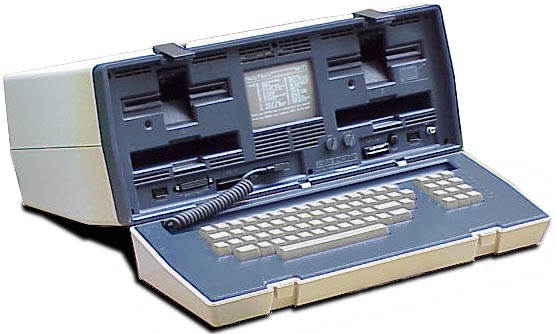 |
Osborn1 |
Do you remember Osborn1?
Osborn1 was the very first portable computer in the world. Was Osborn1 a bad name? No, absolutely not. Osborn1, in my opinion, is a great name for a very first product. Did the name kill the product? No, absolutely not. Compare the picture to your right with your current laptop and you know why. Osborn1 was truly a marvel at its time. Great, great computer and I mean it.
For small entrepreneurs, however, the important concepts for choosing a good name are "right, related, witty, and visionary ". Right names are more important and not "a secret formula name" that will do magic for you. You still need to have that magical product that will fulfill your customers' dream.
The other important factor is relevancy. If you are Apple, Google, and Yahoo, you can choose any name you fancy. So they did! When you receive a check for $20 million from your venture capital firm, you can also name your company "Cypress". However, relevancy always helps when you prefer your name to indicate your service.
How could Pentium (if you have $40,000 to spend on naming as Intel did on Pentium) be a bad processor (or in our case a bad name)? After inventing three generations of processors at Intel, Pentium better be Darn Good. How could Powerbook be a bad computer after Apple had already done all its mistake with Lisa and MacIntosh. Was Lisa a bad name? No. Absolutely not. The name Lisa definitely did not kill the new product from Apple. It was the price of $10,000 and the complexity of the product that killed Lisa. Lisa was the very first Window featured computer from Apple (actually credit should go to Xerox labs in Palo Alto for inventing the concept of Window, also Mouse, and Ethernet).
Remember Newton? Was Newton a bad name for Apple's first handheld notepad? No, I believe it was actually a great name. Newton, however, died. Why? It was the fact that Apple rushed an incomplete product out (forced to rush it out) that killed the product. Newton was the original design for Palm from 3COM. The inventor of Newton just moved from Apple to 3COM and naturally his concept moved with him.
Is Palm a bad name or a good name? No one should really care. Palm worked. Or, actually the good old Newton finally matured and worked right.
Yes, if your company is as reliable as Isuzu, how can "Outback" be a bad name? I am sure you get the idea. If you have a Winner, why not just call it "Winner"?
Naming is not a science. Naming is an art. We are not linguists or scientists. Good products make good names, however, smart, sassy, pleasing names signal your intelligence, your credibility, and your wit. Most of us don't have that 20-million-dollar check from our venture capital firm to choose a name like Yahoo, Apple, or even Google. Most of us have an idea, a new product, and a need for a name to signal a true genius behind the product.
Can you even imagine forking out nearly 20,000 dollars for a computer with 64K RAM? I can’t imagine what the people during that era of computer buying must have gone through. The price tags on these computers that you are about to see were beyond outrageous. In the 80s computers that weighed 55 pounds were called portable computers and now we whine if they are over 5 pounds. We sure as hell are spoiled cause personally I wouldn’t fork out more than 1000 dollars for a nice rig. Check out these images, although they were the roots for modern day computers, they were ugly as hell and the price no matter what anybody says didn’t justify whatsoever.
Presenting the ugliest computers from the past that came with outrageous price tags. Enjoy!

Radio Shack TRS - 80 Model II (1979)
Price : $3,450 (32K RAM)
$3,899 (64 K Ram)

Osborne 1 - Considered to be the first portable computer (1981)
Price : $1,795 (32K RAM)

Otrona Attache (1982)
Price : $3,995 (64K RAM)

Apple Lisa (1983)
Price : $9,995 (1MB)

Apple III (1981)
Price : $3,495 (128K RAM)
$3,815 (w/ monitor)

Compaq Portable III (1987)
Price : $4,999 (20MB HD)
$5,799 (40MB HD)

Dynabyte (1981)
Price : $2,375 (64K RAM)

IBM 5120 (1980)
Price : $9,340 (w/ printer)

IBM Portable PC 5155 (1984)
Price : $4,225 (256 - 640K RAM)

IBM Portable PC (1975)
Price : $19,975 (64K RAM)
A simple shift in a vowel's sound can change the way people think and make decisions about objects – leading to a greater connection between a brand's name and product features a business wants to highlight, says new research from UTSC and UTM.
"When you see a table, you call it a table and know what to expect," says Sam Maglio, an assistant professor in UTSC's Department of Management. "But since there's no such reference for a new product, businesses need to find an engaging brand name that attracts consumers and helps them make sense of what they're buying. We found vowel sounds can achieve that."
The study looked at two different types of vowel sounds, defined by the highest point the tongue lands in the mouth as the sound is said. "Front vowel" sounds such as those in bee or bay, are made with the tongue forward, while the tongue is to the rear of the mouth with "back vowel" sounds such as but or boot.
"Previous work has shown that cross-culturally, people associate front and back vowel sounds with specific expectations," says Maglio. "Front sounds are matched with notions of sharpness, brightness and being small, while back sounds are associated with dullness, darkness and being large."
Maglio and the research team – which included University of Toronto Mississauga psychology post-doctoral fellow Cristina Rabaglia – found that vowel sounds go beyond what people think about objects, for instance if they should be big or small. Vowel sound can in fact influence how people process and prioritize information to make decisions related to the object.
"These speech sounds can influence how people think," says Rabaglia. "This clarifies our psychological relationship with the fundamental building blocks of language."
"We're not talking about a big distance in your mouth, but the sounds are very psychologically salient," she says, noting that many languages make this distinction.
"Since the right brand name can make or break a new product's success, generating the best name is vital for business," says Maglio. "By using appropriate vowel sounds, you can highlight the product features you want your customers to value – leading to potentially greater consumer interest or increased sales."
The team found that when faced with back vowels, people tended to make decisions that valued the desirability of an object over its feasibility (buying a delicious food that was shelved across a store rather than a less tasty one that happened to be close at hand).
With back vowels, people preferred primary over secondary features: hand lotion that worked well but was in unattractive packaging over average lotion with pretty packaging. They also prioritized long-term over short term benefits, such as a massage that was initially painful but offered months of relief versus one that was soothing but only for a few days.
The opposite preferences occurred when people were provided with foods, lotions and massages that had front vowels in their names.
"The smallest components of words, the building blocks we use to make words, are very subtle," says Maglio. "But they're capable of changing the way we think about those named objects."
The research is published online in the Journal of Experimental Psychology: General.
Explore further: Pictorial mnemonics and sound contrasting yield more effective English teaching
Journal reference: Journal of Experimental Psychology: General
Provided by University of Toronto Mississauga